Intrinsic cognitive load can be reduced by breaking down the subject content, sequencing the delivery so that sub-tasks are taught individually before being explained together as a whole. The idea is to not overwhelm a student too early on in the introduction of new work.
Ayres tested the effectiveness of teaching strategies to reduce cognitive load by reducing task complexity (intrinsic cognitive load). Three groups of 13-year-old students were asked to study a math task under different conditions. The strategy adopted by a group (isolated) is to use partial tasks in which the constituent elements are isolated from each other (elemental isolation). The second group (integration group) accepts the entire task in which all elements are fully integrated, and the third group (mixed group) adopts a hybrid strategy that progresses from part of the task to the entire task. The results show that the partial-task strategy can effectively reduce the cognitive load for all students, but the learning effect is better for students with low prior knowledge. In contrast, students with higher a priori knowledge have significantly more overall tasks in the teaching process than some tasks. The mixed mode approach proved to be ineffective for both levels of prior knowledge. These results were discussed using cognitive load theory.
New learning may be quite short-lived. If there is no opportunity to process the information, the information will soon disappear from the student’s mind.
For example,the teacher can present a series of examples before the teacher asks the students to complete the task. For example, teachers can show them how to draw an exponential curve before reminding them how to apply the exponential law. Then they will complete the exercises on these issues.
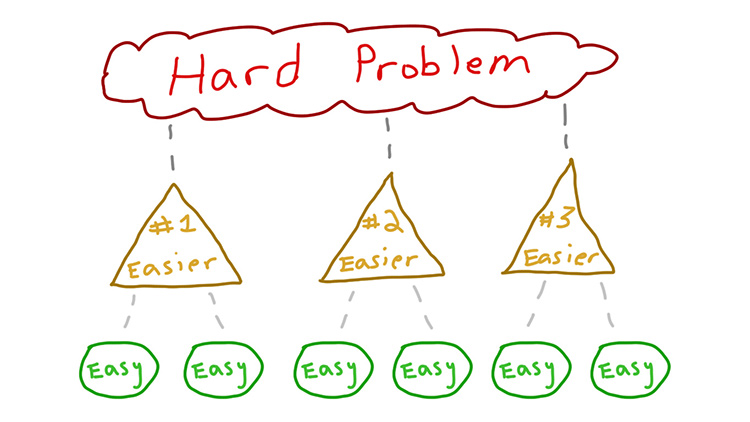
Teachers can train their student’s ability to resist Intrinsic cognitive load. Students can break down difficult goals into simple goals to relieve Intrinsic cognitive load by themselves。
reference
Ayres, P. (2006). Impact of reducing intrinsic cognitive load on learning in a mathematical domain. Applied Cognitive Psychology: The Official Journal of the Society for Applied Research in Memory and Cognition, 20(3), 287-298.

 Cognitivie Load Theory (CLT)